Key Takeaways
-
There is no official medical schedule for Reiki stress relief; the best frequency is the one that feels calming, fits your budget, and suits your life.
-
Studies that showed benefit used about 30-45 minute sessions weekly for six weeks, but these findings are small and should be treated as clues, not rules.
-
Weekly Reiki suits short, intense stress periods, while monthly sessions work well for ongoing upkeep and steady stress levels.
-
Try a short trial of one session a week for four to six weeks, then track your mood, sleep, and stress on a 1-10 scale to guide spacing.
-
Session length matters: give yourself enough time to unwind fully rather than rushing, and avoid scheduling tight commitments right afterward.
-
Reiki is a complementary relaxation practice and cannot replace therapy, medication, or medical treatment for severe or lasting stress or anxiety.
If stress has been following you around lately, you may be wondering how often should you get Reiki for stress relief. It is a fair question, and the honest answer is a little different for everyone. There is no single schedule that works for all people. Think of it like deciding how often to go for a walk. Some folks love a daily stroll, while others are happy with a weekend wander.
In this friendly guide, we will compare two popular choices: a weekly Reiki rhythm and a monthly one. We will look at what the research says, what it does not say, and how to pick a plan that fits your life. Whether you are a busy professional, an expecting mom, an athlete, a senior, or a wellness lover, you will find ideas you can use. We will keep things simple and kind. Let us dive in!
The Honest Truth About Reiki Frequency
Let us start with the most important point. There is no official, medically required Reiki schedule for stress relief. Health authorities describe the overall evidence for Reiki as limited and mixed. The National Center for Complementary and Integrative Health notes that Reiki has not been clearly shown to work for any health-related purpose, and many studies are small or low in quality.
So why talk about frequency at all? Because many people find Reiki to be a calming, quiet break from a loud world. At a massage therapy studio, Reiki is best seen as an optional relaxation practice. It is a gentle way to pause, breathe, and rest. Your best schedule is the one that feels good, fits your budget, and helps you feel more at ease.
If you are brand new to the practice, this overview of what healing Reiki is and how it can help you is a great place to start.

What the Research Suggests (and What It Does Not)
Researchers have looked at Reiki schedules in a few studies. The results are interesting, but they are not a prescription.
- A 2022 review of placebo-controlled studies found that, for people with clinically meaningful stress, the schedules linked with improvement were about 30 to 45 minutes once a week for six weeks.
- The same review noted one study of stress in the normal range that used 60 to 90 minute weekly sessions for more than six weeks.
- A 2025 meta-analysis of 11 randomized trials with 661 participants found a small improvement in quality of life overall. Better results were linked with eight or more sessions of at least 60 minutes.
- A 2024 anxiety review covering 824 adults reported a notable pooled effect, but results varied a lot by group and session frequency.
Here is the catch. These studies were small, used different methods, and measured different things. The quality-of-life findings do not prove a stress-specific dose, and anxiety is related to stress but is not the same thing. So please treat these numbers as helpful clues, not rules.
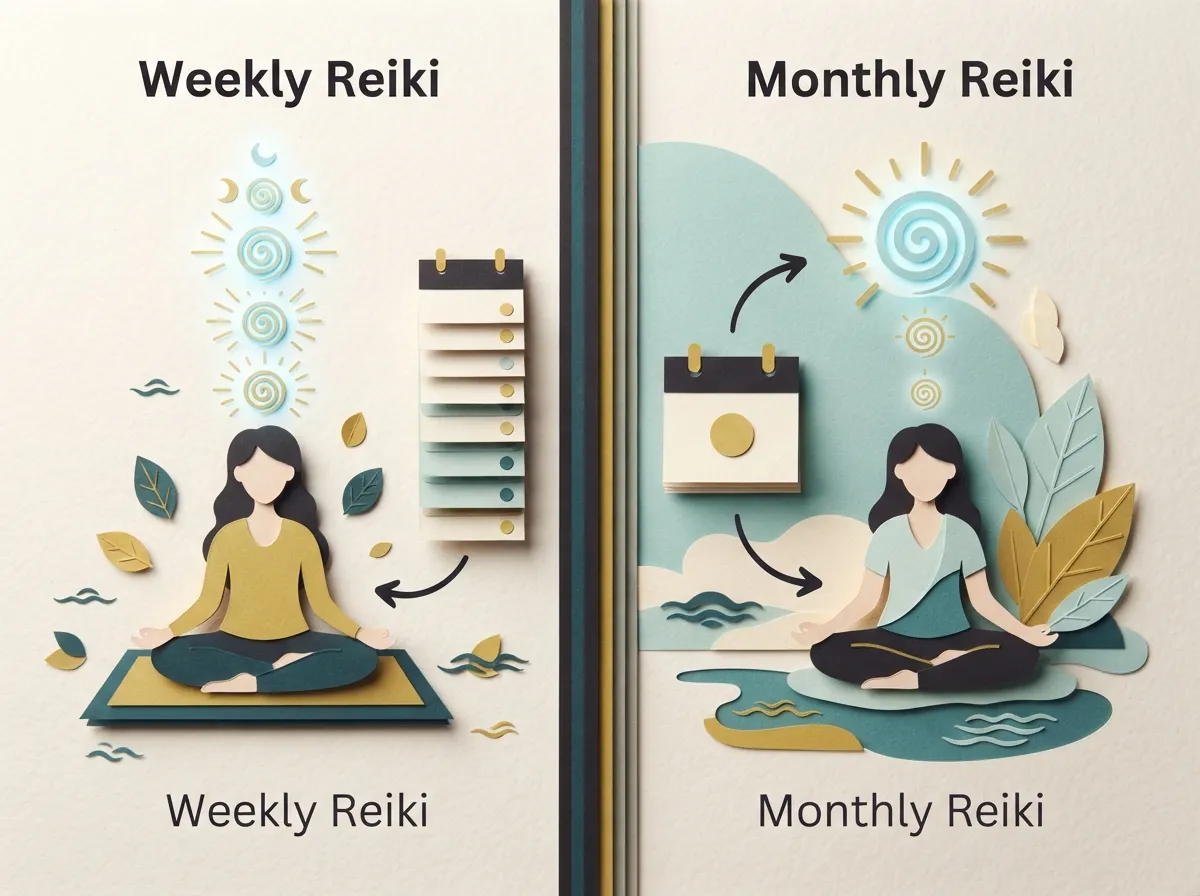
Weekly vs. Monthly Reiki: A Side-by-Side Look
Now for the fun part. Here is how the two most popular rhythms compare in real life.
| Feature | Weekly Reiki | Monthly Reiki |
|---|---|---|
| Best for | High-stress seasons, big life changes | Ongoing upkeep and self-care |
| Matches research schedules | Yes, closer to the weekly studies | No, less studied |
| Time commitment | Higher | Lower |
| Cost over time | Higher | Easier on the budget |
| Feeling of routine | Strong, steady rhythm | Relaxed, flexible rhythm |
| Good first step? | Great for a short trial | Great for easing in |
Neither choice is better. They simply serve different needs. Many people start weekly for a few weeks, then shift to a monthly visit once they feel steadier.
The Case for Weekly Reiki
A weekly rhythm is the closest match to what researchers have studied. If you are in a tough stretch, such as a work deadline, a move, or a family challenge, weekly sessions can give you a steady anchor.
Who Might Enjoy Weekly Sessions
- Busy professionals who need a regular reset before or after a long work week
- Anyone going through a short, intense season of stress
- People who like structure and a predictable self-care habit
- Wellness-focused folks who want to build a strong routine
How a Weekly Plan Might Look
A simple approach is to try one session a week for about six weeks. That mirrors the schedule used in some studies. After six weeks, check in with yourself. Do you feel calmer? Do you sleep a bit better? Do you enjoy the quiet time? If yes, you can keep going or ease back.
Remember, this is a personal trial and not a medical treatment plan. Your own comfort is the best guide.
The Case for Monthly Reiki
Monthly Reiki is a gentle, sustainable choice. It works well when your stress is steady but not overwhelming. It also fits busy calendars and careful budgets.
Who Might Enjoy Monthly Sessions
- Seniors who want a soothing, low-pressure routine alongside other wellness care
- Athletes who pair Reiki with training recovery and use it as a calm mental reset
- Expecting moms who want a quiet moment between prenatal massage visits
- Anyone who just likes a regular tune-up for the mind
A monthly visit gives you something to look forward to. It also gives you a built-in pause on the calendar. Many people find that simple habit helpful all by itself.
How Long Should Each Session Be?
Session length matters too. The studied schedules ranged from 30 to 90 minutes. At Luna Massage Studio, Reiki Healing is offered at a flat rate of $125. If you are curious about timing, this guide on how long a typical Reiki session lasts breaks it down nicely.
For stress relief, many people like sessions that are long enough to truly settle in. A rushed visit can feel like squeezing a nap into a coffee break. Give yourself time to unwind, and try not to schedule a tight meeting right afterward.
A Simple Way to Find Your Own Rhythm
Not sure where to begin? Try this easy step-by-step plan.
- Start with a short trial. Book one session a week for four to six weeks, or two sessions a month if weekly feels like too much.
- Keep a tiny journal. After each visit, jot down your mood, sleep, and stress level on a scale of one to ten.
- Notice patterns. Do you feel best for two days or for two weeks? Your answer helps you pick your spacing.
- Adjust with kindness. If you feel great, stretch the time between visits. If stress spikes, shorten it again.
- Check in with your budget and calendar. The best plan is one you can keep without added worry.
Want more detail on pacing? You may also like how many Reiki sessions you need to see results.
How Soon Might You Notice a Difference?
This varies from person to person. Some people feel relaxed right after their very first session. Others feel a quiet calm that builds over several visits. A few feel little at all, and that is okay too.
Because Reiki is a relaxation practice, a lot of the benefit may come from the stillness, the gentle atmosphere, and the time set aside just for you. Those things are real and worth valuing. If you want to explore this more, read about Reiki vs. placebo and what an honest look at the evidence says.
Pairing Reiki With Massage for Extra Calm
Here is a lovely secret. Reiki and massage can team up nicely. Reiki uses light touch or hands held just above the body, while massage works on tight muscles and tension. Together they can cover both body and mind.
Some clients alternate: Reiki one visit, a Swedish or deep tissue massage the next. Others add free aromatherapy to a massage for an extra layer of calm. If you want to compare the two, this piece on Reiki healing vs. massage and which eases stress best can help you decide.
At Luna Massage Studio in Falls Church, VA, our team can help you build a mix that suits your body and your schedule. You can also visit us on Google — Luna Massage Studio to see what our clients say, or peek at our friendly updates on Instagram.
Is Reiki Safe, and Does It Need Touch?
Reiki is generally gentle. The NCCIH reports that it has not been shown to have harmful effects. Practitioners use light touch or hold their hands just above your body, and your comfort and consent come first. If you prefer no touch at all, that can usually be arranged.
If you want a deeper look, our guide on how to tell if Reiki is safe for you covers the details. You can also read a general background on Reiki healing if you like to explore the history.
Important: Reiki Is Not a Replacement for Care
Please hear this part with a warm heart. Reiki is a complementary relaxation service. It does not replace therapy, medication, or medical treatment. If your stress or anxiety is severe, lasts a long time, or makes daily life hard, please reach out to a qualified health professional.
A good Reiki visit can be one kind piece of a bigger self-care puzzle. It should never be the only piece when you truly need support. For more on this topic, see can Reiki replace medical treatment and what you should know.
Quick Schedule Ideas for Different Lifestyles
To make this easy, here are a few simple starting points. Adjust them to feel right for you.
- Busy professional: Weekly for six weeks during a heavy work season, then monthly. Evening or weekend slots can fit around long days.
- Expecting mom: Monthly Reiki, or alternate with prenatal massage. Always check with your care provider first.
- Athlete or active adult: Every two to four weeks, timed around hard training blocks or big events.
- Senior: Monthly or every other week, paired with gentle massage if it feels good.
- Wellness-focused person: A steady monthly habit, with extra visits during stressful stretches.
Final Thoughts: Your Calm, Your Pace
So, how often should you get Reiki for stress relief? The kind answer is this: as often as it helps you feel calm and as often as your life allows. Weekly sessions can work well for a short, stressful stretch, and monthly sessions are a lovely way to keep your calm over time. The research offers clues, not commands, so trust how you feel.
Start small, notice what helps, and be gentle with yourself along the way. You deserve rest, and a quiet hour can go a long way. Ready to find your rhythm? Book your Reiki session today, or get in touch with our friendly team at Luna Massage Studio to talk through the best plan for you.
FAQs
Q: How often should you get Reiki for stress relief?
A: There is no official schedule, so it is a personal choice. Some studies used about 30 to 45 minute sessions once a week for six weeks, but that is not a rule. Start with what feels good and fits your life, then adjust as you go.
Q: How soon might I notice a difference after Reiki?
A: Everyone is different! Some people feel relaxed right after a session, while others notice calm that builds over a few visits. A few feel little change, and that is perfectly normal too.
Q: Can Reiki replace therapy, medication, or medical care?
A: No, it cannot. Reiki is a gentle, complementary relaxation practice and not a treatment for any condition. If your stress or anxiety is strong or lasting, please talk with a qualified health professional.
Q: Is Reiki safe, and can it be done without touch?
A: Reiki is generally gentle, and the NCCIH reports it has not been shown to cause harm. It uses light touch or hands held just above the body, so no-touch sessions are usually possible. Your comfort always comes first.
Q: What should I expect during a Reiki session at a massage studio?
A: You will rest comfortably, fully clothed, while the practitioner uses light touch or hovering hands in a quiet, calm room. Most people find it peaceful and easy. Our guide on what to expect in a Reiki massage session shares more details.
Our Service Area