Key Takeaways
-
Ask about training specifics: which teacher, what level, and how many hands-on practice hours. Reiki titles and certificates are not standardized, so a certificate alone reveals little.
-
Confirm whether you can choose hands-off Reiki and whether you can stop the session at any time. Consent should be respected throughout, and you should never feel pressured to accept touch.
-
Be wary of practitioners who promise cures, tell you to stop prescribed medication or skip doctor visits, or push a large prepaid package before you have tried one session.
-
Ask what Reiki can and cannot do. The NCCIH reports it has not been clearly shown to be effective for any health purpose, so a responsible practitioner calls it complementary.
-
Clarify whether the appointment is Reiki only, massage only, or both, plus the exact price, session length, and cancellation policy before booking.
-
Share relevant health conditions, pregnancy, or mobility limits on the intake form, and ask how the practitioner will adapt positioning and handle emotional reactions.
Booking your first Reiki session can feel a little like walking into a new neighborhood café. You are curious, a bit hopeful, and maybe slightly unsure what to order. That is completely normal! If you have been wondering what questions should I ask a Reiki healer before booking, you are already doing something smart. A few good questions can turn a nervous “maybe” into a confident “yes.”
Reiki is a gentle, hands-on or hands-near practice that many people use to relax and unwind. It is a complementary practice, not a replacement for medical care or massage. Whether you are a busy professional chasing calm after a long week, an expectant mom looking for comfort, an athlete winding down, a senior managing stiffness, or someone who loves a good self-care ritual, the right questions help you find the right fit.
In this guide, we walk you through the questions that matter most, why they matter, and what a good answer sounds like. Let’s get you ready for a session you feel great about.

Why Asking Questions First Is So Important
Reiki is not a standardized field. Training, titles, and styles can vary quite a bit from one practitioner to the next. That means a little homework up front helps you land in the hands of someone you trust.
Here is a quick snapshot of what the research says. According to the National Center for Complementary and Integrative Health (NCCIH), Reiki has not been clearly shown to be effective for any health-related purpose. The NCCIH also notes there is no scientific evidence for the energy field Reiki is thought to use. At the same time, the NCCIH reports Reiki has not been shown to have harmful effects.
What does that mean for you? Many people simply enjoy Reiki as a quiet, calming experience. Going in with realistic expectations, and a few smart questions, helps you enjoy it even more. If you want a deeper background first, our guide on what healing Reiki is and how it can help you is a great place to start.
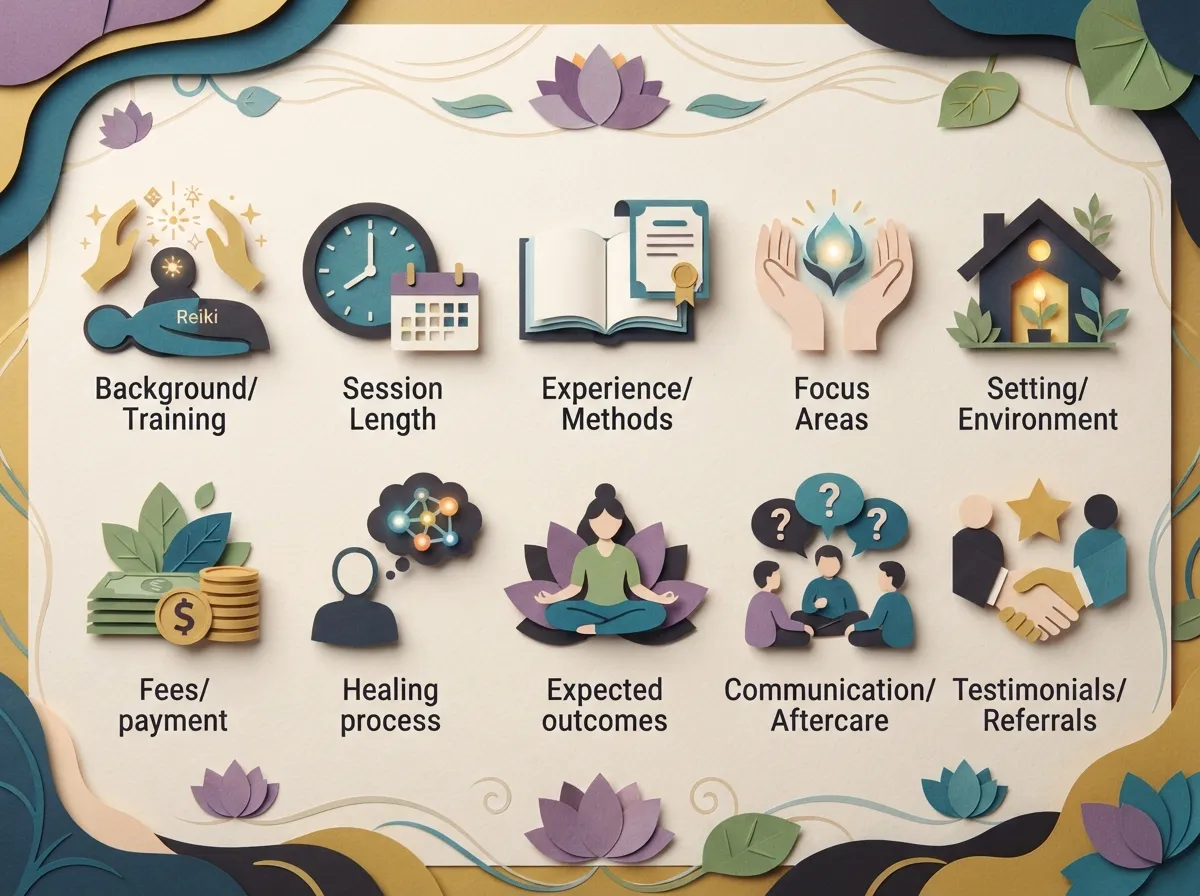
Quick Checklist: The Questions at a Glance
Short on time? Here is a quick-scan table you can screenshot and keep on your phone.
| Topic | Question to Ask | What a Good Answer Sounds Like |
|---|---|---|
| Training | What Reiki training have you completed? | Names the teacher, level, and hands-on practice hours |
| Licensing | Do you hold any other professional license? | Clear about what the license does and does not cover |
| Session | What happens during a session? | Walks you through each step in plain language |
| Touch | Will you touch me, or hover? | Offers both options and respects your choice |
| Cost | What is the price and length? | Gives a clear flat rate and time up front |
| Claims | What can Reiki do and not do? | Avoids promising cures or diagnoses |
| Health | How do you handle health concerns? | Encourages you to keep seeing your doctor |
| Privacy | How do you protect my information? | Explains intake and confidentiality clearly |
Question 1: What Reiki Training Have You Completed?
This is the first thing to ask. Reiki titles and certificates are not standardized, and there is no single licensing body that covers every practitioner. So a certificate alone does not tell you the whole story.
Try asking these follow-ups:
- Who taught you, and what level of Reiki training did you finish?
- How many hours of supervised or hands-on practice have you done?
- How long have you been offering sessions to clients?
A good practitioner will answer openly and happily. If you want help narrowing down options in your area, these 6 steps to find a certified Reiki practitioner near you can help.
Question 2: Do You Hold Any Other Professional License?
Some Reiki practitioners are also licensed massage therapists or other health professionals. That can be a nice bonus, because licensed professionals follow clear standards of conduct.
It is worth asking which services their license actually covers. Reiki and massage are not the same thing. Reiki is typically done fully clothed, with light touch or hands held just above the body. Massage involves hands-on manipulation of muscles and soft tissue. Our breakdown of how Reiki healing differs from massage therapy explains this in more detail.
If you are curious which professional suits your goals, this comparison of a Reiki master versus a massage therapist is a handy read.
Question 3: What Exactly Happens During a Session?
Nobody likes surprises when they are trying to relax. Ask the practitioner to walk you through the session from start to finish.
A friendly answer will usually cover:
- A short chat about how you are feeling and what you hope for.
- How you will be positioned, usually lying on a table or sitting comfortably.
- Whether you stay fully clothed (most Reiki sessions are clothed).
- How long the quiet hands-on or hands-near portion lasts.
- A short check-in at the end to talk about how you feel.
You can also read what a first visit looks like in our guide to 12 things to expect at your first Reiki session.
Question 4: Will You Touch Me, and Can I Choose Hands-Off Reiki?
This one is all about comfort and consent. Some people love gentle touch. Others prefer the practitioner to keep their hands a few inches above the body. Both are common ways to receive Reiki.
Ask these questions:
- Do you use light touch, hovering hands, or both?
- Which areas of the body might you approach?
- Can I ask you to switch to hands-off work at any time?
- Can I stop the session whenever I want?
A caring practitioner will welcome these questions. Consent should be talked about before the session and respected the whole way through. You should never feel pressured to accept touch you do not want.
Question 5: Is This Reiki Only, Massage Only, or Both?
If you are booking at a massage studio, this question matters a lot. Some places offer Reiki as its own appointment. Others blend it with massage. Make sure you know exactly what you are signing up for.
For example, at Luna Massage Studio, Reiki Healing is offered as its own service. If you would like to try a blended experience, you can learn more in our post about what to expect in a Reiki massage session.
Ask the studio to confirm three things: what is included, how much of the time is Reiki, and how much (if any) is massage. That way, there are no mix-ups on the day.
Question 6: What Are Your Price, Session Length, and Cancellation Policy?
Clear pricing is a sign of a trustworthy business. Ask for the full picture before you book.
- How long is one session?
- What does it cost, and is there any extra fee?
- What is your cancellation or rescheduling policy?
- Is the space accessible if I use a cane, walker, or wheelchair?
For reference, a typical session length is covered in our post on how long a Reiki session lasts. At Luna Massage Studio, Reiki Healing is a flat $125 per session, so you know the cost before you walk in.
Also, be a little cautious about pressure to prepay for a big package before you have tried a single session. A good practitioner lets you try one first and decide later.
Question 7: Do You Recommend One Session or a Series?
Some people feel a calming effect after one visit. Others like to come back on a regular schedule. A thoughtful practitioner will not push a set number of visits on you.
Ask what they suggest and why. Then compare that with your own goals and budget. Our guides on how many Reiki sessions you need and weekly versus monthly Reiki can help you think it through.
Question 8: What Can Reiki Do, and What Can It Not Do?
This is one of the most important questions on the list. A responsible practitioner is honest about the limits of Reiki.
Here is what to listen for:
- They describe Reiki as complementary, not a cure.
- They do not diagnose conditions or promise to fix an illness.
- They never tell you to stop taking prescribed medicine or skip a doctor visit.
- They are comfortable saying, “The research is still limited.”
The NCCIH also reports that there is not enough high-quality research to say whether Reiki helps relieve chronic pain. So if you live with ongoing pain, Reiki may be a nice add-on for relaxation, but it should sit alongside your medical care. You can read more in our honest look at whether Reiki can replace medical treatment.
Question 9: How Do You Handle Health Concerns and Emotional Reactions?
Sometimes a quiet session brings up feelings, or you may have a health condition the practitioner should know about. Ask how they handle those moments.
Good questions include:
- What do you ask about on the intake form?
- What do you do if I feel uncomfortable or emotional during the session?
- Will you work with my healthcare team if that is helpful?
If you are pregnant, ask whether the practitioner is comfortable adapting the session for you. If you are a senior with arthritis or limited mobility, ask how they can adjust positioning so you stay comfortable. And if you are extra sensitive to sights, sounds, or smells, these Reiki session tips for highly sensitive people may help.
It is also smart to ask about safety. Reiki is generally considered low risk, and you can read more in our guide on how to tell if Reiki is safe for you.
Question 10: How Do You Protect My Privacy and Boundaries?
A professional space should feel safe, calm, and respectful. Ask how your personal information is kept private and what the practitioner does to set clear boundaries.
A good answer will mention a confidential intake process, a quiet and private room, and a clear promise that you can end the session at any time without pressure. This matters even more in a massage setting, where professional conduct is part of the experience.
Red Flags to Watch For
Most Reiki practitioners are kind, sincere people. Still, it helps to know the warning signs. Think twice if a practitioner:
- Promises to cure an illness or guarantees results.
- Tells you to stop prescribed treatment or skip medical care.
- Pushes you to prepay for a large package right away.
- Will not explain their training or answer your questions.
- Makes you feel uncomfortable about touch or boundaries.
Trust your gut. If something feels off, it is perfectly fine to walk away and keep looking.
Do Your Own Quick Research Too
Questions are just one piece of the puzzle. Take a few minutes to read online reviews, look at the studio’s social media, and see how the business talks about its services. You can check Luna Massage Studio’s profile on Instagram, read feedback on Yelp, and see what clients say when you visit us on Google — Luna Massage Studio.
For more on what makes a great review-worthy studio, see how to find Falls Church’s best Reiki massage reviews. And if you are comparing Reiki with massage for stress, our post on Reiki healing versus massage is a friendly side-by-side look.
A Simple Way to Use This List
You do not have to ask every single question out loud. Here is an easy plan:
- Pick your top three questions based on what matters most to you.
- Send them in an email or ask them by phone before booking.
- Notice how the practitioner answers. Do they sound calm, clear, and kind?
- Book a single session first, with no long-term commitment.
- Afterward, ask yourself how you felt and whether you would return.
That is it! You are in charge of your experience the whole way through.
Ready to Book Your Reiki Session?
Asking the right questions helps you feel calm and confident long before you step through the door. Look for clear training, honest talk about what Reiki can and cannot do, respect for your boundaries, and straightforward pricing. If a practitioner checks those boxes, you are likely in good hands.
At Luna Massage Studio in Falls Church, VA, we are always happy to answer your questions before you book. Reiki Healing is a flat $125, and we are glad to walk you through exactly what to expect. Book your Reiki session now, or contact our team or call 703-254-0422 with any questions. We would love to help you feel your best.
FAQs
Q: What should I ask a Reiki practitioner before my first session?
A: Start with their training, what happens during a session, whether they use touch or hover their hands, and the price and length. It also helps to ask what Reiki can and cannot do. A good practitioner will answer warmly and clearly.
Q: Is Reiki the same as massage therapy?
A: Nope, they are different! Reiki is usually done fully clothed with light touch or hands held just above the body, while massage involves hands-on work on muscles and soft tissue. It is a good idea to confirm whether your appointment is Reiki, massage, or both.
Q: Do Reiki practitioners need a license?
A: Reiki training and titles are not standardized or generally licensed, so a certificate alone does not tell you much. If your practitioner is also a licensed massage therapist, ask which services their license covers.
Q: Can I ask for hands-off Reiki?
A: Absolutely! Many people prefer the practitioner to keep their hands a few inches above the body. You can request this before or during your session, and you can stop at any time.
Q: Is Reiki safe, and can it replace medical care?
A: The NCCIH says Reiki has not been shown to have harmful effects, but it also has not been clearly shown to treat any health condition. Think of it as a relaxing complement to your care, never a replacement for your doctor.
Our Service Area